
Learning-as-Flux
The Lake
Flux → chosen entry → supported movement → return
Water is the field. Swimming is agency in motion.
The Lake preserves Learning-as-Flux: a learner enters a live field, meets resistance, receives proportional support, and retains the right to re-enter or exit with dignity intact.
▸ Open MaxCP
▸ ◉ Key Insight
The Lake preserves the water metaphor for Learning-as-Flux. A learner enters the water when they choose engagement. Adults protect safety, dignity, agency, and re-entry without swimming the learner’s strokes for them.
▸ ⚡ Mantras
- Still water is not absence.
- Floating is not failure.
- Treading water is effort.
- Support is a tool, not an identity.
- Re-entry is a right.
▸ ↺ Flowchart
Goal becomes live → learner approaches the water.
Entry is chosen → Flux begins.
Resistance appears → read movement, not motives.
Cost rises → offer proportional support.
Support holds → fade it gently.
Loop closes → re-enter, revise, rest, or leave clean.
▸ ⌘ Micro-Lexicon
- The Lake — metaphor surface for Learning-as-Flux.
- Water — the live field of motion, resistance, uncertainty, and possibility.
- Swimming — learner-owned agency expressed through movement.
- Lifeguard — adult posture that protects safety and dignity without taking over agency.
- Re-entry — the learner’s right to return after reset, refusal, rest, or stabilization.
Entry
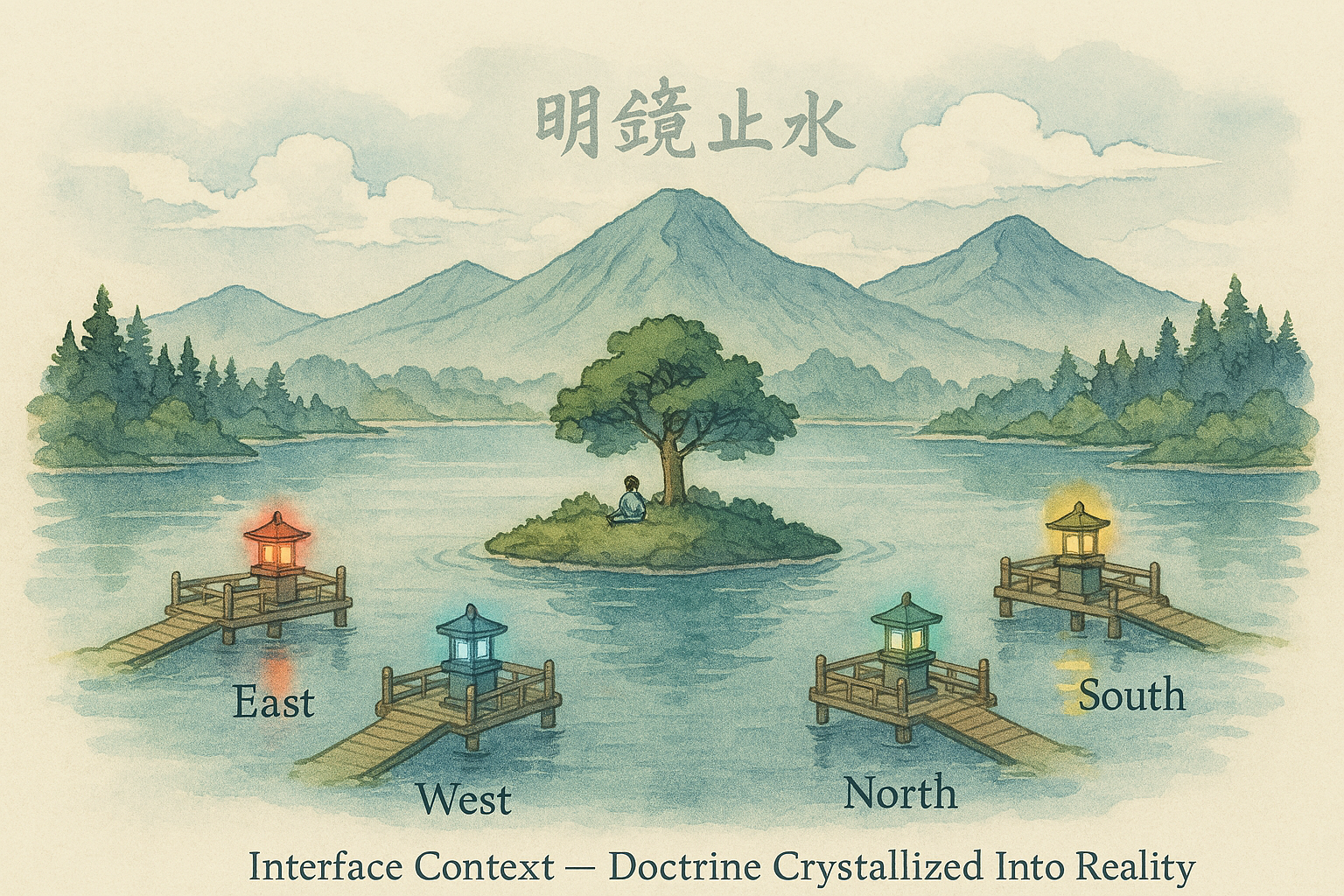
The Lake is one of ARF’s oldest images.
Before the framework had sharper instruments, it already knew this:
learning is not a straight hallway.
It is water.
It moves under the learner, around the learner, and through the field. It asks adults to keep the shore visible while the child learns how movement feels.
Orientation Stream
This page refreshes the old homepage lake without flattening the softness out of it.
Water
The live field: moving, responsive, uncertain, and full of possibility.
Flux
Learning changes as conditions change. The learner is not moving through a hallway; they are moving in a living field.
Chosen Entry
The learner approaches, tests, steps in, pauses, or waits. Entry belongs to them.
Swimming
Learner-owned movement becomes visible through action, adjustment, rhythm, and return.
Lifeguard
Adults protect safety, dignity, and re-entry without becoming the swimmer.
Re-entry
Leaving the water does not end the story. The shore remains visible so return stays possible.
What The Lake Is
Water is the Flux context.
Entering the water is the moment a learner chooses to engage.
Adults are lifeguards: they protect agency and dignity while keeping re-entry visible.
Supports are tools, not identities.
The lake does not ask whether the learner is “good at swimming.”
It asks:
What is the current?
What is the cost?
What support is available?
Can the learner still choose?
That is where the metaphor still carries.
Learner States
These are not labels. They are observable field states.
Swimming
Actions appear controlled, patterned, and self-directed.
The learner is moving through the field with usable agency.
Treading Water
Effort is high and organization is low.
This may be the learner’s best available movement while the field remains expensive.
Floating
Outward activity reduces so capacity can return.
Stillness can be adaptive when it remains learner-owned.
Submerged / Stabilizing
Safety, dignity, or agency is no longer reliably intact.
Learning goals pause. Stabilization comes first. Re-entry remains a right.
Lifeguard Doctrine
Adults do not own the lake.
Adults protect the conditions that make swimming possible.
Watch the Water
Read patterns, timing, repetition, proximity, exits, peer response, body cues, and changes in control.
Stay close enough to notice. Stay soft enough that the learner still owns the movement.
Change the Current
Adjust the field: timing, tools, task size, peer arrangement, adult proximity, or route back in.
Good support changes conditions before asking the learner to push harder.
Do Not Become the Float Forever
Support is allowed. Permanent adult carry is not the goal.
If the learner can only stay afloat while the adult holds the whole lake, the support plan needs a gentler exit path.
Keep the Shore Visible
Reset is not exile. Exit is not shame.
Re-entry should remain visible before the learner needs it.
Proportional Support Cycle
Support changes conditions so the learner can move.
Support does not become the learner’s new identity.
1. Observe the Water
Notice what is changing before deciding what it means.
Patterns before interpretations. Always.
2. Offer the Smallest Float
Change the least amount required for the learner to regain usable movement.
One gentle support. Then watch what changes.
3. Check the Ripples
Did support reduce cost? Did movement return? Did dignity hold?
If not, pause and re-read.
4. Fade the Float
When the learner carries the next movement, reduce adult support.
If the field holds without you, leave quietly and cleanly.
Shoreline Memory
The old Lake once carried four shoreline roles.
That image can stay as memory, not as a current doctrine gate.
▸ Old Shoreline Roles
The old model used shoreline seats to name different support positions around the learner: family, school, systems, and specialist contexts.
The current read is simpler:
- Everyone faces the same lake.
- Roles differ.
- Aim does not.
- No adult role becomes the centre.
The learner owns the swimming. Adults arrange, protect, and fade.
▸ The Center Island
The old image held a center island: the learner’s lived story.
That still carries, as long as it is not treated as a destination adults drag the learner toward.
It is orientation, not ownership.
The learner’s story is not extracted from them. It becomes visible through chosen movement, refusal, repair, and return.
Bias-Resistance & Observability
The lake helps adults notice projection gently and early.
Some unfamiliar swimming may simply be unfamiliar. Some quiet may be restoration. Some movement may be learning how to move.
The adult task is to observe before interpreting.
Difference ≠ Danger
Unusual movement, silence, intensity, repetition, or pacing is not automatically unsafe.
Read control, pattern, consent, and impact before intervening.
Adult Comfort Is Not the Shoreline
Adult discomfort can be useful information, but it is not automatic proof of learner danger.
The clean read looks at the whole field: the learner, the current, the support, the exits, and the cost.
Safety & Stabilization
Sometimes the correct move is not more learning.
Sometimes the correct move is preserving life, dignity, and future re-entry.
If the learner is no longer able to access safe movement, preserve dignity first. The lesson can wait. The child cannot be treated as collateral.
This is not exclusion.
This is protecting the shore so return remains possible.
Gentle Truth
A learner who stops swimming may not be refusing growth. They may be protecting the possibility of future movement. If the only visible path costs too much, restore payable movement first.
Floating may be wisdom.
Treading may be maximum effort.
Leaving the water may be the cleanest available movement.
The shore should remain kind enough to return to.
Pattern Hints
Use these when the lake feels quiet, unclear, or slower than the adult expected.
Read the state gently. Name the observable movement first. Avoid turning the learner’s current state into a character judgment.
Offer the smallest float. Support should reduce cost while preserving learner-owned movement.
Keep the shore open. If the learner pauses, leaves, or stabilizes, make return feel possible before it is needed.
Claim Boundary
The Lake is an ARF metaphor interface.
It is not a diagnostic model. It is not a behaviour scale. It is not a way to sort children.
It is an image for preserving agency while movement happens under resistance.
The lake carries only when the learner owns the swimming, support remains proportional, and re-entry stays visible.
CTA Rail
The lake stays soft. The doctrine stays kind. The shore stays open.